
With a pH value of 2 to 2.5, the stomach is one of the most acidic areas of the human body. It breaks down food and protects us by killing many of the pathogens we ingest every day. This environment is lethal to most microorganisms, with one notable exception: Helicobacter pylori, in short: H. pylori.
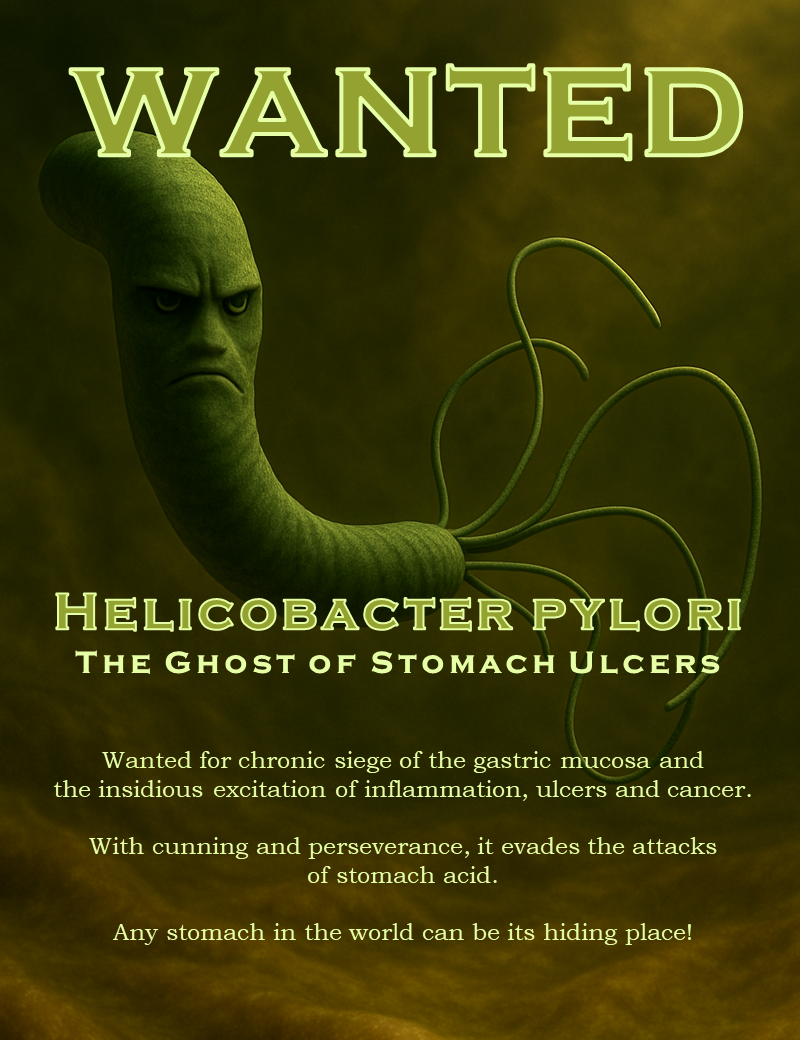
Helicobacter pylori – Acidity is its home
H. pylori is a bacterium that has developed special mechanisms to survive in the acidic environment of the stomach and colonise the stomach lining. Around half of the world's population carries it, usually without showing any symptoms. However, the infection can have serious consequences for those affected: from chronic inflammation and stomach ulcers to an increased risk of stomach cancer. It is no wonder that shortly after its discovery in 1994, H. pylori was classified as carcinogenic by the WHO.
The self-experiment that had H. pylori exposed
Although H. pylori has probably been present in humans for around 100,000 years, it was only discovered a few decades ago, along with the diseases it causes. Until the early 1980s, it was believed that no bacteria could survive the acidic environment of the stomach. Instead, stomach ulcers were attributed to stress or an unhealthy lifestyle.
In 1982, Australian researchers Robin Warren and Barry Marshall isolated H. pylori from the gastric mucosa. The discovery was initially met with great scepticism. To prove causality, Marshall drank a culture containing live H. pylori. Shortly afterwards, he developed typical gastritis symptoms such as nausea, vomiting and stomach pain. He was then able to isolate H. pylori from his stomach lining again, thus fulfilling Koch's postulates. Warren and Marshall were awarded the Nobel Prize in Medicine in 2005 for this work.
Infection: how does H. pylori enter the stomach?
Infection with H. pylori usually occurs during childhood and, if left untreated, persists throughout life. The exact route of transmission is not fully understood. However, researchers assume that infection occurs predominantly from person to person, especially within the family through close physical contact. Transmission via saliva (oral-oral) and via faecally contaminated material (oral-faecal) are being discussed. Infection through contaminated water is also possible, but is not considered to be the main cause.
Symptoms: how does the body react to H. pylori?
Most infections go unnoticed, with around 90% of those affected showing no symptoms. If symptoms do occur, they are usually non-specific: recurring upper abdominal pain, bloating, nausea, loss of appetite or bad breath. In rare cases, vomiting, flatulence or heartburn may occur.
In the long term, however, H. pylori increases the risk of serious diseases: 1–10% of those infected develop stomach ulcers or duodenal ulcers. Even rarer, but particularly serious, are complications such as gastric cancer or MALT lymphoma. Despite the relatively low individual probability, H. pylori is one of the most significant carcinogenic infections due to its worldwide prevalence.
Diagnosis: how can you determine whether you are carrying H. pylori ?
Invasive and non-invasive procedures are available to detect infection:
Invasive procedures:
- Gastroscopy with biopsy: Tissue samples are taken from the stomach lining and examined histologically. This allows the bacteria to be detected, changes in the mucous membrane to be assessed, urease activity to be tested (rapid urease test) or the bacteria to be cultured. These methods are considered very reliable.
Non-invasive procedures:
- Urease breath test: The person being tested drinks a labelled urea solution; when broken down by the bacterial urease enzyme, measurable carbon dioxide is produced in the exhaled air. Very reliable, but not always suitable for children or pregnant women.
- Stool antigen test (SAT): Detects H. pyloriantigens in a stool sample. Simple and well suited for initial diagnosis and therapy monitoring.
- Serology (antibody detection in blood): Can indicate a current or past infection, but is not suitable for monitoring successful treatment.
Treatment: how can H. pylori be eliminated?
The standard treatment is known as eradication therapy, usually lasting 10–14 days, consisting of a combination of several antibiotics and a proton pump inhibitor:
- Triple therapy: Two antibiotics (e.g. amoxicillin and clarithromycin) + proton pump inhibitor
- Quadruple therapy: Tetracycline + metronidazole + bismuth salt + proton pump inhibitor
As H. pylori is increasingly developing resistance, the choice of medication often needs to be adapted to local resistance rates.
Infect-Net experts for H. pylori are:

Professor Dr Sina Bartfeld heads the Bartfeld Laboratory at the Technical University of Berlin. She researches the human body's response to infections, innate immunity and the development of cancer. Her laboratory focuses in particular on how epithelial and immune cells trigger inflammatory responses via pattern recognition receptors (PRRs), for example in infections with H. pylori. To this end, they use modern in vitro models such as organoids and organ-on-a-chip systems.
Professor Dr Cynthia Sharma leads the Department of Molecular Infection Biology II at the University of Würzburg. Her group researches the gene regulation of H. pylori and Campylobacter jejuni, focusing on post-transcriptional control by small RNAs and RNA-binding proteins, supported by high-throughput sequencing, translome analyses and 3D tissue models.
Sources:
- DocCheck. (o. J.). Magen. DocCheck Flexikon. https://flexikon.doccheck.com/de/Magen
- Ahmed, N. (2005). 23 years of the discovery of Helicobacter pylori: Is the debate over? Annals of Clinical Microbiology and Antimicrobials, 4, 17. https://doi.org/10.1186/1476-0711-4-17
- Kayali, S., Manfredi, M., Gaiani, F., Bianchi, L., Bizzarri, B., Leandro, G., Di Mario, F., & de’Angelis, G. L. (2019). Helicobacter pylori: Transmission routes and recurrence of infection – state of the art. World Journal of Gastroenterology, 25(36), 5670–5679. https://doi.org/10.3748/wjg.v25.i36.5670
- Smith, S. M. (Hrsg.). (2021). Helicobacter pylori: Methods and Protocols. Springer Nature. https://doi.org/10.1007/978-1-0716-1302-3
- Kamiya, S., & Backert, S. (Hrsg.). (2019). Helicobacter pylori in Human Diseases. In Advances in Experimental Medicine and Biology (Bd. 1149). Springer. https://doi.org/10.1007/978-3-030-21916-1
- DocCheck. (o. J.). Helicobacter pylori. DocCheck Flexikon. https://flexikon.doccheck.com/de/Helicobacter_pylori
Ailín Österlein-Kück | Public Outreach Infect-Net
René Lesnik | Coordination Infect-Net
 English
  German