
Sequencing, Visibility and Diagnostics
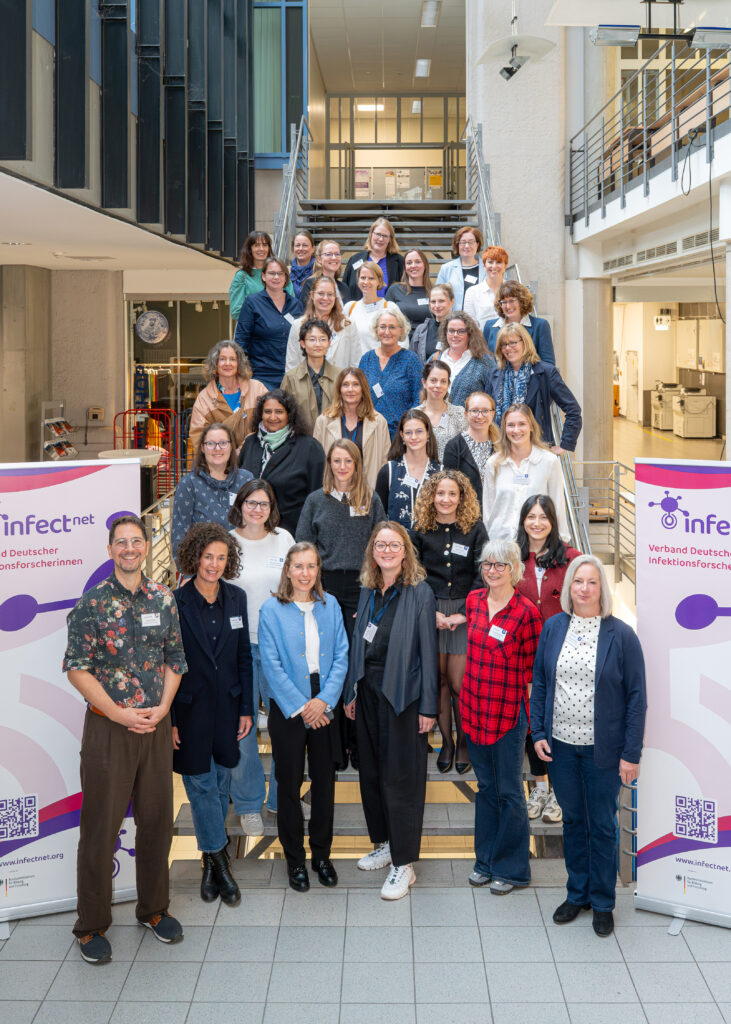
On 24 and 25 September, Infect-Net chairwoman Prof Dr Bettina Löffler invited participants to the sixth network meeting in Jena. Immediately following the 77th Annual Meeting of the German Society for Hygiene and Microbiology (DGHM), 45 infection researchers from all over Germany gathered at the Friedrich Schiller University and Jena University Hospital (UKJ). The focus was on current developments in the sequencing and diagnosis of infectious diseases and the question of how our newly founded association can gain even more visibility and influence for infection researchers in the future.
Welcome address
In her opening speech, association chairwoman Prof Dr Gabriele Pradel addressed current social and political trends towards traditional role models and patriarchal power structures. These developments increasingly call gender equality and equal opportunities into question. According to Pradel, this makes the role of women's networks all the more important in defending privileges and rights and demanding a say in society. Infect-Net aims to make a decisive contribution to this, not only for women in infection research. Pradel also thanked her colleagues on the project board who helped her launch and shape the Infect-Net network initiative.
The hosts then presented their research location, Jena:
Prof Dr Bettina Löffler, Director of the Institute for Medical Microbiology at the UKJ, provided exciting insights into her research on antimicrobial surface structures for implants and 3D models of bone tissue. Her colleague PD Dr Stefanie Deinhardt-Emmer presented the new Leibniz Centre for Photonics in Infection Research (LPI) and used her own work to show how high-resolution imaging techniques such as atomic force microscopy (AFM), Raman spectroscopy and fluorescence lifetime microscopy (FLIM) can be used to visualise pathogens at the cellular level and for pathogen diagnostics.
Keynote speech by Lia van der Hoek: Hunting for unknown viruses
One highlight of the meeting was the keynote speech by Dutch virologist Prof Dr Lia van der Hoek from Amsterdam University Medical Centre. As an expert in detecting previously unknown viruses, she took us on a fascinating scientific ‘detective journey’: she researches rare and mysterious viral infections in humans and animals. In addition to identifying new pathogens, she also develops approaches for vaccines and therapies. Her presentation impressively demonstrated how much curiosity, perseverance and passion goes into this research.
Research live – and at the highest level
The keynote speech was followed by an intensive scientific exchange:
- Dr Sandra Reuter (Freiburg University Hospital) highlighted the importance of plasmid diversity and its precise sequencing for the clonal determination of bacterial hospital germs.
- Dr Antje Häder (UKJ) spoke about TERC RNA molecules and their influence on infections with the influenza A virus.
- PD Dr Geraldine Nouailles (Charité Berlin) used respiratory pathogens as an example to show how single-cell sequencing contributes to the precise characterisation of immune cell populations.
- Dr Romy Skusa (University Medical Centre Rostock) presented the potential of bacteriophages as antibacterial therapeutics and advocated standardised agar-based methods for phage isolation.
- Dr Noriko Cassman (UKJ) emphasised the importance of uniform research data management and presented VIRJenDB , a database that supports precisely that.
Workshop: High-throughput sequencing in theory and practice
The subsequent hands-on workshop focused on the application of high-throughput sequencing in routine diagnostics.
Dr Isabell Abellan Schneyder from Oxford Nanopore Technologies gave a clear explanation of the sequencing mechanism behind nanopore technology and its advantages for diagnostics. Noriko Cassman supplemented this with an overview of the bioinformatic processing and evaluation of sequencing data.
During the subsequent laboratory tour at the UKJ, participants were able to experience modern, automated diagnostics live: an impressive insight, even for experienced infectious disease specialists.
From a funded project to an independent association
Another focus of the meeting was our future as an independent association. René Lesnik, project coordinator at Infect-Net, presented the strategy for transforming the funded network into a volunteer-run collective. In future, teams of Infect-Net members will take on tasks such as onboarding, website maintenance, social media and policy engagement. The challenge is to distribute responsibilities in such a way that they remain compatible with the professional commitments of the members. The intensive discussion revealed which formats and strategies have proven particularly successful so far and which ideas will be incorporated into the new association's work.
Board members Prof Dr Antje Flieger and Prof Dr Clarissa Prazeres da Costa took the opportunity to warmly thank René Lesnik for his commitment and continuous support. His appreciative manner has made Infect-Net ‘more than just a network’.
Interdisciplinary networking
In addition to the scientific programme, there was plenty of opportunity for personal encounters and interdisciplinary exchange. Whether at the get-together after the presentations or over sundowners in a relaxed atmosphere, conversations across disciplinary boundaries and career levels opened up new perspectives and laid the foundation for future collaborations. This is something we at Infect-Net particularly value.
Thank you to all the ‘Innovative Women in Focus’
We would like to thank all speakers and participants for their inspiring contributions and lively discussions. It was a wonderful time in Jena!
Special thanks go to our hosts Bettina Löffler, Stefanie Deinhardt-Emmer and Vera Voltersen for the invitation, Felix Müller, Lucy Wahler and Yini Zhang for their outstanding support on site, and Delikart Partyservice Jena for the excellent catering.
This sixth network meeting was also the last event held as part of the Federal Ministry of Education and Research's ‘Focus on Innovative Women’ funding programme. With the funding period coming to an end on 30 September 2025, we would like to express our sincere thanks to the funding programme and the Meta-IFiF meta-project: without their support, Infect-Net would not have been possible in its current form.
What happens next?
Even when funding ends, Infect-Net will remain active!
As an independent association, we are continuing our mission to connect female infection researchers and raise their profile. The next network meeting is already being planned: in autumn 2026, we will meet in Würzburg at the invitation of Prof Dr Franziska Faber and Prof Dr Stefanie KampmeierThis will also be the first general meeting of the Association of German Female Infection Researchers (Verband Deutscher Infektionsforscherinnen e. V.).
We are looking forward to it and will, of course, keep you updated on our next steps!
René Lesnik | Coordination Infect-Net
 English
  German